Person signal
Identity, pose, silhouette and visible features anchor the wearer.
ViWear AI
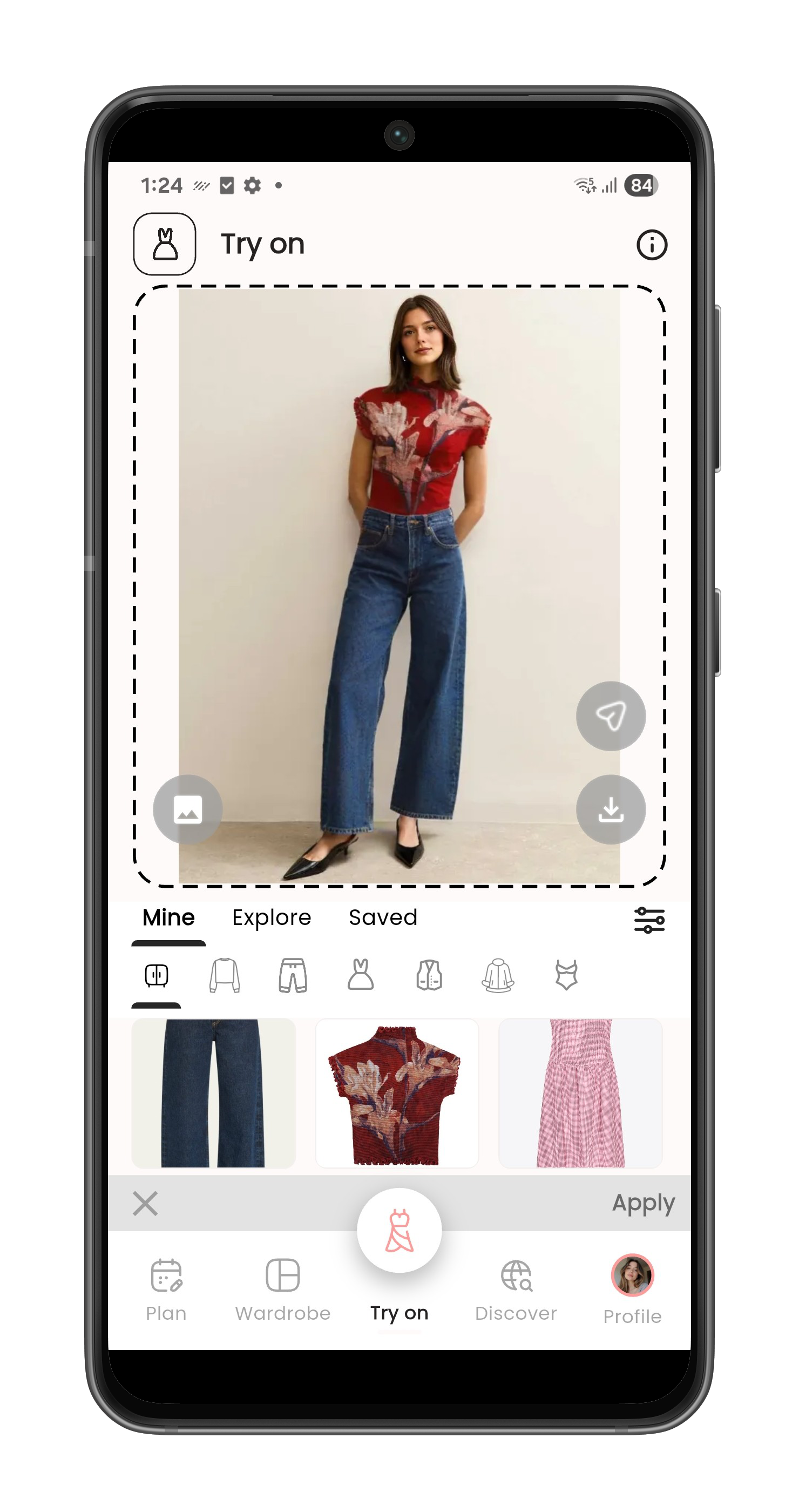
Our generative pipeline brings a person and a garment into the same visual context. It preserves the wearer while synthesizing a plausible new look.
Diffusion, simply
Diffusion models learn to reverse a corruption process: they start from a noisy representation and progressively recover a coherent image. Latent diffusion performs this work in a compressed visual space, reducing computation while retaining useful detail.
Modern FLUX systems sit in the same generative family but use flow matching. A transformer learns a continuous path from noise toward the target image. For virtual try on, the essential idea is unchanged. Visual references guide the generation instead of a text prompt acting alone.
Why conditioning matters
A useful try on system has multiple truths to respect at once. It needs the garment’s design language, the wearer’s identity and body geometry, and enough scene context for the result to feel believable.
Identity, pose, silhouette and visible features anchor the wearer.
Cut, color, texture and local details guide what must be transferred.
The model supplies learned knowledge of bodies, fabric and photographic structure.
A new image that balances fidelity with visual coherence.
The ViWear pipeline
The person image and garment asset are normalized so the model receives consistent visual inputs.
Person and garment representations capture broad semantics alongside detailed appearance cues.
The system establishes which visual regions may change and which identity and scene information should remain stable.
A finely adapted image transformation model progressively resolves the conditioned latent representation into a coherent try on result.
Outputs are checked for visual quality and product consistency before entering the customer experience.
This is a broad product view. ViWear’s model weights, training data strategy and production orchestration remain proprietary.
The hard part
Research into diffusion methods for virtual try on consistently points to the same challenge. The image must look natural without losing the specific identity of the garment or wearer.
Small logos, seams, prints and proportions can be washed out by a generator. Conditioning at both semantic and feature levels helps preserve what makes the item specific.
The edit should change clothing while preserving the face, hair, pose and environment. Controlled regions and strong reference signals reduce unwanted drift.
Fabric must follow body shape and pose. Attention mechanisms help align garment information with the correct body regions.
Hands, occlusions, unusual poses and layered garments remain difficult. Quality controls matter as much as the generative model itself.
Our technical direction
ViWear’s proprietary virtual try on work is built around an adapted FLUX architecture for image transformation. The foundation offers strong contextual generation. ViWear adds value by adapting that capability to fashion conditioning, repeatable use and product experiences informed by wardrobe context.
Privacy by design
ViWear processes user images with explicit consent and does not use them to train AI models.
Clear user control before images enter the try on flow.
User images are not repurposed for model training.
Stored in Belgium with retention, access and deletion controls designed around GDPR.
Research foundations